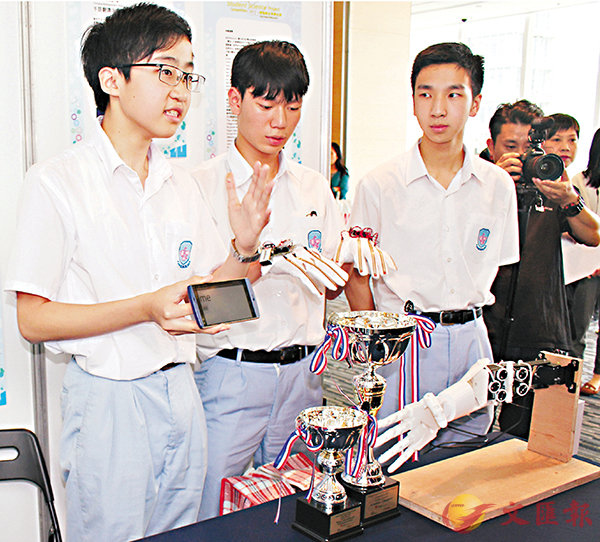
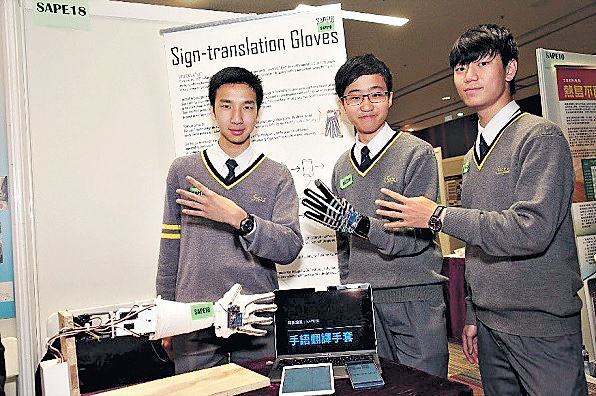
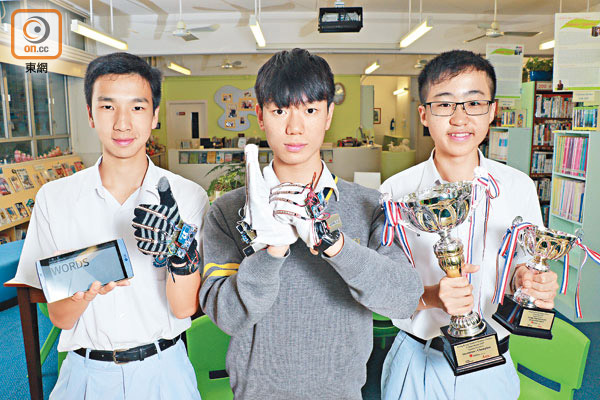
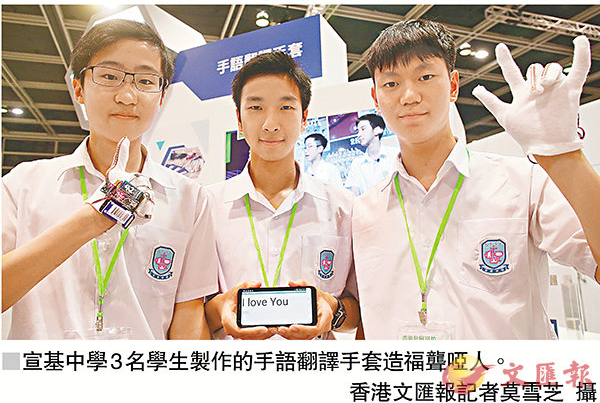
In the middle of last year two students at the University of Washington developed SignAloud, a pair of sign-language translation gloves that work with a computer: put them on, and signs are matched against a database and turned directly into speech and text. Less than a year later, secondary-school students in Hong Kong have taken the idea further. Three Form 5 students from Christian Alliance Sun Kei Secondary School — Noddy Chung, Jacky Chan and Michael Ng — have made a portable sign-language translation glove that translates with a phone app, so that deaf and mute people can communicate with those around them.
Built for what signers actually need
The same meaning is signed differently in different parts of the world — a thumbs-up means "very good" in Hong Kong but can be an insult elsewhere. The three noticed how regional sign language is, and that was where the idea came from: a glove that could help a deaf or mute person talk to a foreigner. As the article noted, the sign-language apps already on the market are mostly teaching tools, and almost none of them translate.
Meaning inferred from bend and bearing
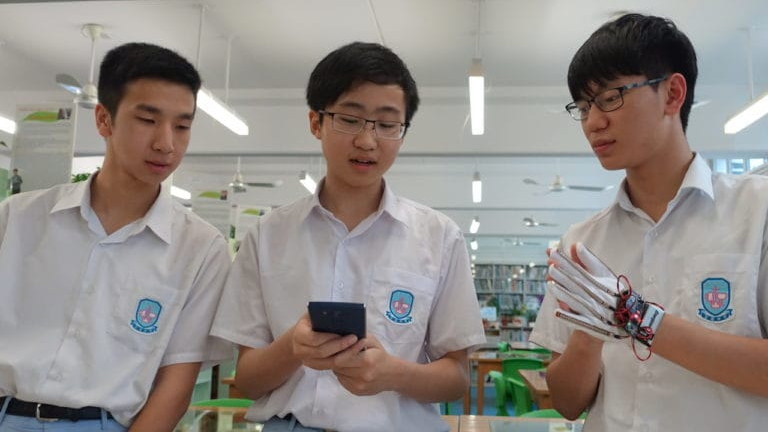
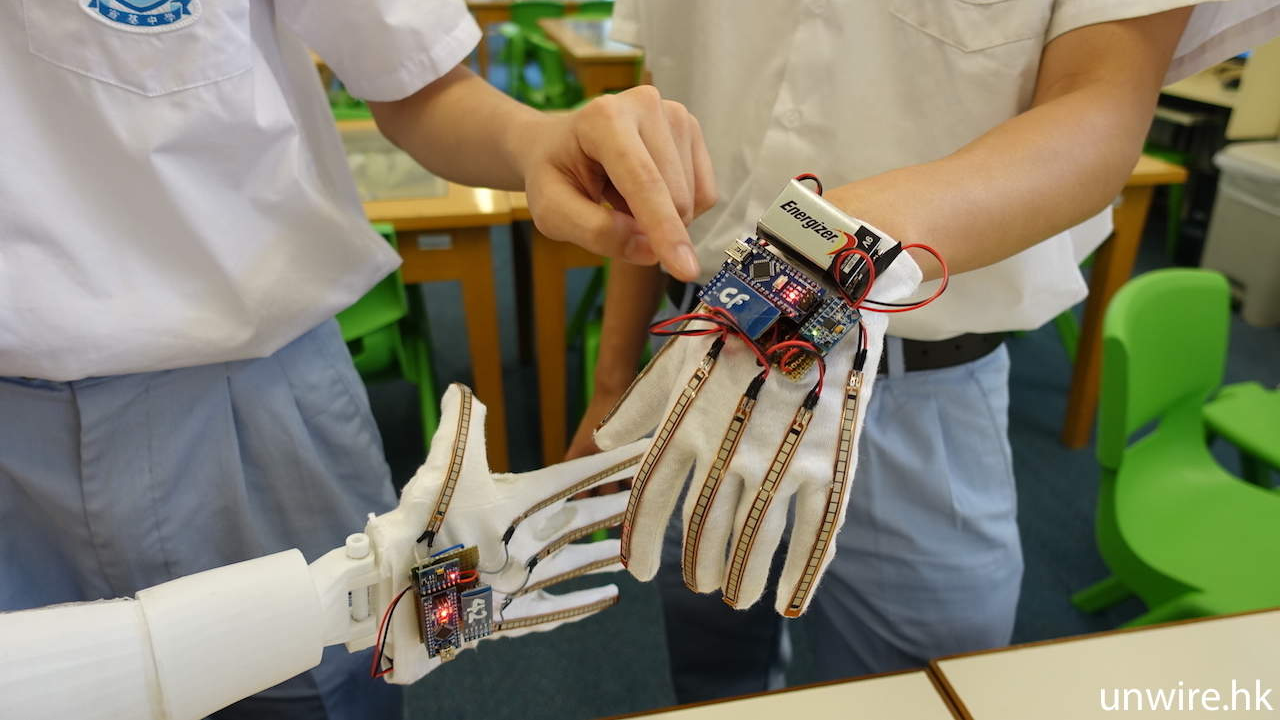
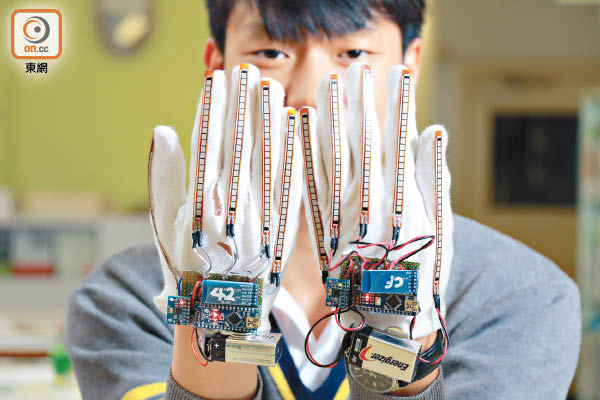
The glove has three main parts: flex sensors at the fingers, a three-axis gyroscope, and a Bluetooth transmitter. The flex sensors and the gyroscope collect the data of the hand shape and its movement; the Bluetooth transmitter sends that data to a phone app. The app is the processing centre — it matches the sign against the phrases in its database and then outputs text and speech. All the main components sit on the back of the hand.
Jacky joked that the demonstration set includes "I love you", handy for confessing to a classmate you like. And when the team saw the bird in the UNWIRE logo, they set the sign for "bird" to translate as UNWIRE.HK.
Eighty-five per cent accurate
Noddy led the hardware. He said the hardest part of the build was tuning the sensitivity of the sensors: there are so many possible hand positions, and the sensors are so sensitive, that the smallest change in a gesture changes the data. A lot of time went into the maths of how that data was calculated, to make it more accurate. After the tuning, the team put the glove's accuracy at about eighty-five per cent, though the database did not yet hold many phrases.
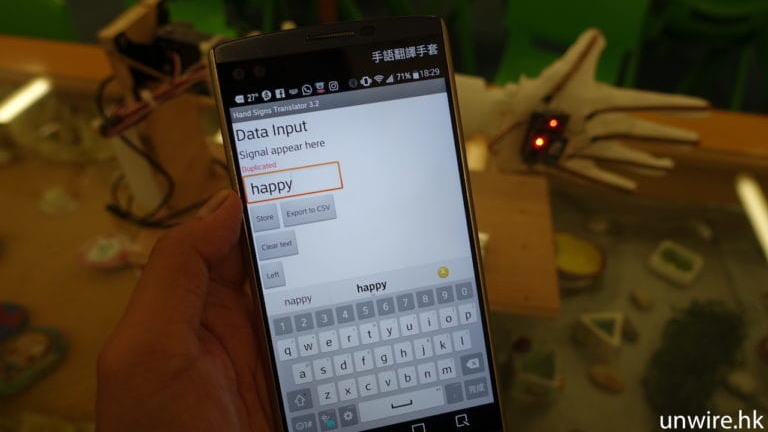
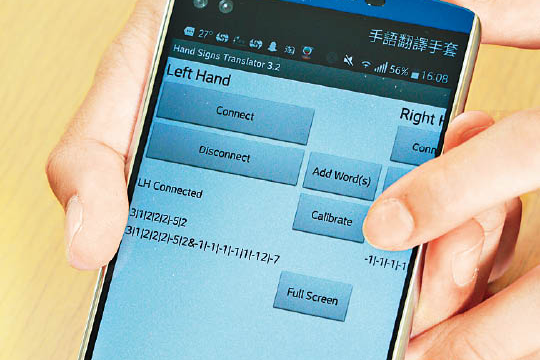
Before making the glove, Noddy had considered several other ways of analysing the motion of a hand. They had found plenty of software online that could do it, but most of it needed a computer connection — not convenient enough, and not accurate enough — so in the end they built the glove and wrote the program themselves. In the app, the numbers at the bottom left of the screen are the raw data coming off the glove: the degree of bend in each finger and the bearing of the hand.
Output in several languages
Jacky handled the phone app. At the time of the interview it translated Hong Kong sign language into English, and he hoped to add French. Asked why those two languages and not Chinese, he explained with a laugh that the development tool they were using did not support Chinese, so there was no way to translate into it yet. Watching how widely the data swung, he brought in an open-source mathematical model to denoise it.
Off to the United States
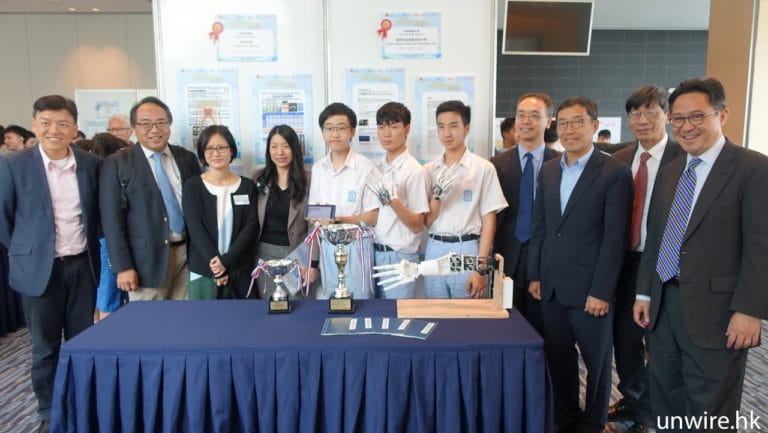
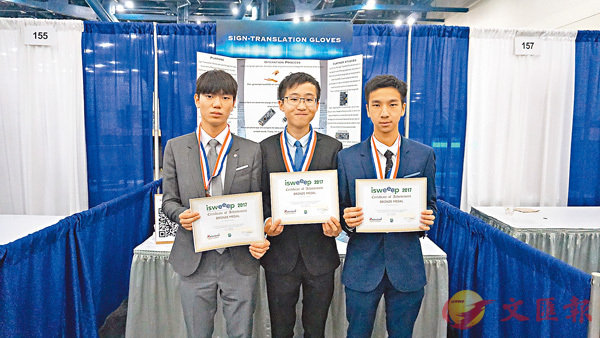
The three took only about three months to build the prototype, and it won them a place at the International Sustainable World Energy, Engineering and Environment Project Olympiad, as well as the championship of the senior-secondary invention category at the Hong Kong Student Science Project Competition. All three said they wanted to keep refining the product, fill out the phrase database, and then put the glove in the hands of deaf and mute users to try. Entering a phrase in the app and signing it once is all it takes to log a new entry.